The Made-to-Measure Boom Is Real — But So Is the Land Grab
A new market report just put a real number on made-to-measure — and it’s growing faster than most of the category expected. On Made-to-Measure Suit Market Report 2026 · Research and Markets · sizing the category through 2030
Every few months a market-research firm puts a number on an industry that mostly runs on referrals, fittings, and a tailor’s memory for a client’s shoulder slope. This time the number is real enough to matter: according to Research and Markets’ newly published Made-to-Measure Suit Market Report 2026, the category grew from $3.34 billion in 2025 to $3.6 billion this year, and it’s forecast to reach $4.95 billion by 2030 — an 8.3% compound annual growth rate, up slightly from the 8% historic pace of the last five years. That’s not a trend piece. That’s a market getting bigger every single year, in a category most people assumed was shrinking as fast as the necktie did. So who’s actually capturing that growth — and is it you? A note on scope: the report’s growth and consolidation figures cover the branded made-to-measure category broadly — the Indochinos and Suitsupplies of the world — not the independent bespoke workroom specifically. But the same demand and the same capital are washing over both, and a handful of its findings quietly rewrite the competitive landscape for anyone cutting cloth to one body.
What the Report Actually Found
The headline driver isn’t nostalgia for craftsmanship. It’s the return of the office. The report attributes growth to “the growth of traditional tailoring and formal wear culture” alongside a straightforward demographic fact: an increasing urban workforce that needs to dress for in-person work again, after years of loungewear defaults. Layered on top of that is a demand shift inside the category itself — the report cites that 69% of consumers now say they specifically value AI-driven personalization when they buy a garment. That’s not a preference for “customization” in the abstract. That’s a preference for tools that make personalization feel instant and precise.
The made-to-measure suit market, 2026: size, growth, and where the capital is going. Source: Research and Markets, Made-to-Measure Suit Market Report 2026.
69% of consumers say AI-driven personalization matters when they buy a garment — a preference for tools that make it feel instant and precise, not a preference for “customization” in the abstract.
Why the Money Is Moving Toward “Systemized” Tailoring
The report’s named players tell you where the capital is actually flowing: alongside legacy houses like Ralph Lauren, Hugo Boss, Zegna, and Kiton, it puts real weight behind Indochino and Suitsupply — companies whose entire pitch is hybrid online-to-offline tailoring, where a customer starts a fit profile on a phone and finishes it in a showroom. Europe still dominates the category today, but Asia Pacific is flagged as the fastest-growing region — which tracks with a rising urban professional class that has no institutional memory of “going to my tailor” and every expectation that a fitting should feel like a modern retail experience, not a ritual. None of that requires an independent workroom to disappear. It requires an independent workroom to stop competing on “we do things the old way” and start competing on “we do things precisely, and fast.”
The Consolidation Signal Independent Tailors Shouldn’t Ignore
Here’s the part of the report that’s easy to skim past: in January 2026, Brand Machine Group acquired Peckham Rye, folding another heritage menswear name into a portfolio built for scale. That’s not an isolated data point — it’s the market telling you how the growth above is actually going to get captured. Roll-up buyers are betting they can take a brand’s reputation for craft and bolt on the operational systems — measurement capture, production scheduling, inventory — that let it serve ten times the clients without ten times the master tailors.
Jan 2026 — Brand Machine Group acquired heritage menswear name Peckham Rye, folding it into a portfolio built for scale rather than craft.
If that’s the playbook for scale, the defensible move for an independent shop isn’t to out-market a roll-up. It’s to close the operational gap they’re paying millions to buy.
Where Independent Workrooms Still Win
We’ve compared phone-based scanning to dedicated 3D body scanners before, and the accuracy gap hasn’t closed.The report also name-checks 3DLook’s “Mobile Tailor 2.0,” a phone-camera body-scanning tool launched in 2023 — proof that even the low end of this market has already moved past tape measures. That’s worth sitting with for a second: if a phone-photo scan is table stakes for a hybrid online brand, a workroom still relying on paper measurement sheets isn’t competing on heritage anymore. It’s just slower.
A phone photo and a dedicated 3D scanner aren’t reading the same body the same way.
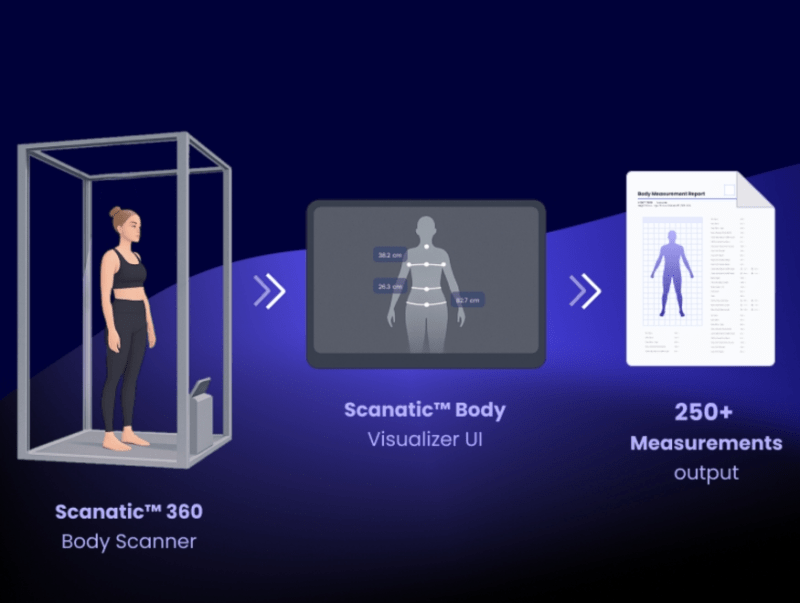
This is exactly the gap a dedicated 3D body scanner closes — not a phone-photo approximation, but capture precise enough to feed directly into pattern adjustment, so a fitting takes one visit instead of three. Paired with a tool like Scanatic™ Studio for building a client-facing lookbook or co-creation session around that same scan data, a two-person workroom can offer a client something no roll-up’s showroom software fully replicates: a fitting that’s both fast and genuinely bespoke, with the same person who scanned you also cutting your pattern.
From a 3-second scan to a 250+ point measurement report — Scanatic’s 3D Body Scanner actual capture-to-spec pipeline.
The Takeaway for Bespoke and Made-to-Measure Tailors
The market isn’t shrinking — it’s growing at 8.3% a year, and the growth is real enough that private equity-backed groups are buying heritage names to get a piece of it. That’s good news for the category and a genuine warning for anyone in it who hasn’t modernized how they measure, fit, and follow up with clients. The tailors who come out ahead over the next five years won’t be the ones who did things the same way for longer. They’ll be the ones who kept the craft and quietly closed the speed gap.
Source: Research and Markets, Made-to-Measure Suit Market Report 2026 (2026). Market sizing, CAGR, regional, and company figures are drawn directly from that report; the workroom interpretations are our own.